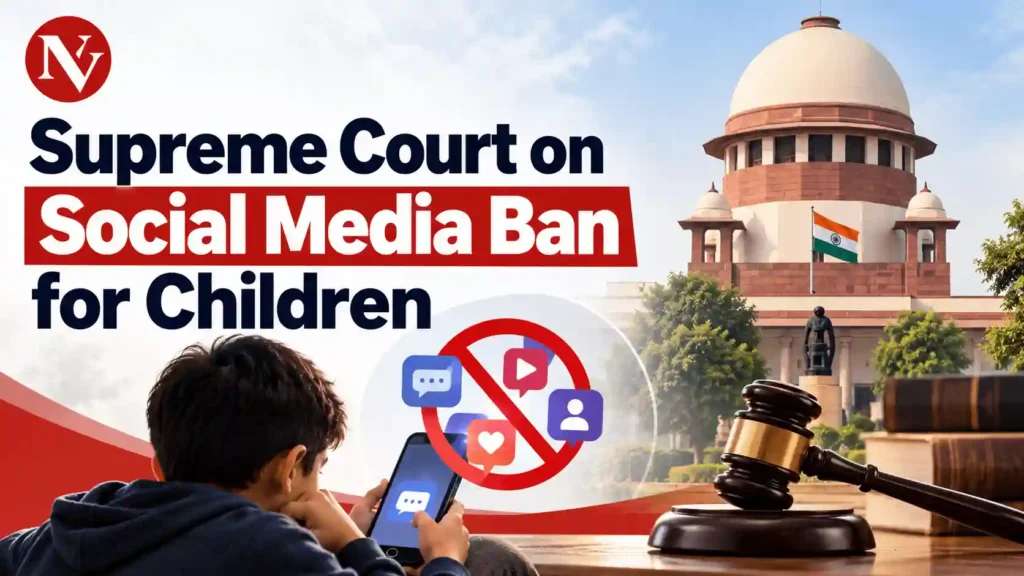
Has the Supreme Court banned social media for children in India? The answer is no. However, two important developments in October 2026 have brought children’s online safety and digital rights into national focus.
On 15 October, the Supreme Court recognised children’s fundamental right to access and use the internet while cautioning against blanket restrictions. A day later, another bench sought the Central government’s response to a petition demanding stronger social media restrictions for minors.
These are separate legal proceedings, and neither means that India has introduced a nationwide social media ban for children.
Here’s what the Court said, what restrictions are being discussed and what parents should know.
What Happened in the Supreme Court on 16 October 2026?
On 16 October 2026, the Supreme Court sought the Centre’s response to a petition seeking restrictions on children’s access to social media platforms.
The petition was filed by Indore-based Emerald Heights International School and its director, Siddharth Singh.
A bench comprising Chief Justice of India Surya Kant and Justice Joymalya Bagchi issued notice to the government and scheduled further proceedings for 7 December 2026.
Why Did the School Approach the Supreme Court?
The petition raises concerns about cyberbullying, online grooming, sexual exploitation, harmful content and excessive social media use.
It also seeks stronger accountability for digital platforms and age-appropriate safeguards.
According to Bar and Bench’s report, the petitioners want a comprehensive regulatory framework rather than relying entirely on voluntary safety measures.
Importantly, the Supreme Court has sought responses. It has not approved the proposed ban.
What Did the Supreme Court Say About Children’s Internet Rights?
In a separate judgment delivered on 15 October 2026, the Supreme Court recognised internet access as a fundamental right available to children as well as adults.
The decision came in Just Rights for Children Alliance v. S. Harish, concerning measures to detect and remove child sexual exploitation and abuse material from online platforms.
A bench of Justices J.B. Pardiwala and K. Vinod Chandran connected internet access with constitutional protections under Articles 19(1)(a) and 21.
Why Did the Court Oppose Blanket Internet Restrictions?
The Court acknowledged that the internet plays an important role in education, communication, access to information and freedom of expression.
It cautioned that completely restricting children’s internet access in the name of safety could interfere with these rights.
Children in remote areas or those relying on digital learning resources could be particularly affected.
However, the Court did not reject child-safety regulations. Instead, it supported targeted safeguards against harmful content and online exploitation.
The judgment’s implications are explained in The Indian Express’s legal analysis.
Internet Ban vs Social Media Ban: What’s the Difference?
The distinction between internet access and social media accounts is important.
| Restriction | What It Means |
| Internet ban | Broad restrictions on accessing online services |
| Social media age restriction | Limits accounts on specified platforms |
| Parental consent | Requires approval for certain activities involving children |
| Child mode | Age-appropriate privacy and safety settings |
For example, restricting a teenager’s social media account does not necessarily prevent them from accessing educational websites.
Similarly, recognising internet access as a fundamental right does not automatically make every possible social media age restriction unconstitutional.
What Social Media Restrictions Are Being Proposed for Children?
The pending petition seeks stronger regulations to protect minors from online harm.
Age Verification and Parental Consent
One proposal involves age-based access restrictions and reliable mechanisms to verify whether an account belongs to a minor.
Parental approval could also become an important part of the regulatory framework.
Greater Responsibility for Social Media Platforms
The petition raises concerns about harmful content, unwanted contact from strangers and platform features that may encourage excessive use.
Possible safeguards include stronger reporting systems, age-appropriate content controls and better enforcement.
However, no final age threshold or nationwide restriction has been ordered in this case.
Why Is a Complete Social Media Ban Controversial?
Supporters of stronger restrictions argue that children face serious risks from cyberbullying, exploitation and inappropriate content.
They believe platforms should be required to provide meaningful protection rather than leaving the responsibility entirely to parents.
On the other hand, critics of blanket restrictions raise concerns about freedom of expression, educational opportunities and children’s privacy.
There is also the practical challenge of age verification. Requiring extensive personal information from every user could create additional privacy risks.
The Supreme Court’s 15 October judgment emphasised that online safety and digital rights must be considered together.
What Are India’s Existing Rules for Children on Social Media?
India already has a legal framework addressing children’s personal data and online safety.
Digital Personal Data Protection Act and Parental Consent
Under the Digital Personal Data Protection Act, 2023, a child is defined as someone below 18 years of age.
Section 9 provides for verifiable parental consent before processing children’s personal data, subject to specified exceptions.
The Digital Personal Data Protection Rules, 2025 explain how parental verification should work.
However, these provisions have a phased implementation schedule. The main child-data consent requirements are scheduled to take effect in May 2027.
Therefore, these rules should not be confused with an already operational nationwide social media ban.
Readers can review the official DPDP commencement notification.
What Is the Child Mode Suggested by the Supreme Court?
The Supreme Court’s 15 October judgment discussed stronger age-appropriate protections for children using social media.
One possibility is a dedicated child mode, allowing minors to access online services with additional safeguards.
How Could Child Mode Work?
Possible features include private accounts by default, restrictions on messages from unknown adults, stronger content moderation, suitable advertising controls and greater parental oversight.
These measures could help reduce online risks without removing children’s access entirely.
However, the Court has not introduced a single mandatory child-mode system across every social media platform.
What Can Parents Do to Keep Children Safe Online?
Parents do not need to wait for new regulations to improve online safety.
They can review privacy settings with their children, discuss suspicious messages and encourage them to report uncomfortable or threatening interactions.
Age-appropriate parental controls can help, but open communication remains important.
Families should also understand risks such as AI-generated impersonation and fraudulent messages. News Vocal’s AI Deepfake Scam Se Kaise Bachein? guide explains how to identify suspicious digital content.
Serious online offences can be reported through India’s National Cyber Crime Reporting Portal.
Which Countries Have Introduced Social Media Age Restrictions?
Australia provides an important international comparison.
From 10 December 2025, Australia began requiring covered social media platforms to take reasonable steps to prevent children under 16 from holding accounts.
The rules focus on platform responsibilities rather than introducing a complete internet ban.
More details are available from the Australian eSafety Commissioner.
India has not adopted the same nationwide approach.
What Happens Next in the Supreme Court Case?
The petition filed by Emerald Heights International School is scheduled for further hearing on 7 December 2026.
The Central government’s response may clarify its position on age-based restrictions, parental consent and platform accountability.
The separate 15 October judgment remains important for understanding how children’s digital rights should be balanced with online safety.
Any new restrictions will depend on subsequent legal or regulatory developments.
Frequently Asked Questions
-
Has the Supreme Court Banned Social Media for Children?
No. As of 20 October 2026, the Supreme Court has not imposed a nationwide ban on children’s social media use. A separate petition seeking restrictions remains pending.
-
Can Children Under 18 Use Social Media in India?
There is no general Supreme Court-imposed under-18 ban. However, individual platforms have their own age requirements, and applicable laws and safety rules remain relevant.
-
What Did the Supreme Court Say About Internet Access?
The Court recognised internet access as a fundamental right, including for children, while supporting proportionate safeguards against online harm.
-
When Is the Next Supreme Court Hearing?
The Emerald Heights social media restrictions petition is scheduled for further hearing on 7 December 2026.
Conclusion
India’s debate over children’s social media use is increasingly focused on balancing online safety with digital rights.
For now, the Supreme Court has not imposed a nationwide ban, and the separate petition seeking age-based restrictions remains pending.
For more updates on court decisions, government regulations, and public policy, explore News Vocal’s India Policy section.