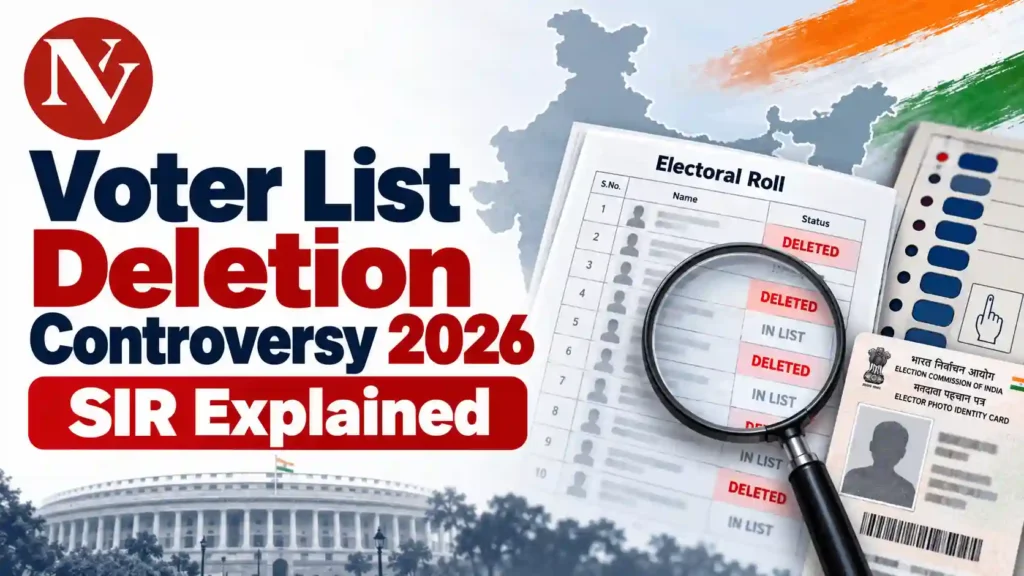
India’s voter list deletion controversy has raised serious questions about electoral transparency and citizens’ voting rights.
During the Election Commission of India’s Special Intensive Revision (SIR), more than 13 crore names were dropped from draft electoral rolls across 30 states and Union Territories, according to data compiled by The Indian Express.
The exercise has triggered political protests, legal challenges and complaints from citizens who say their names were removed incorrectly.
However, 13 crore draft-roll omissions do not mean that 13 crore eligible voters have been permanently denied voting rights.
So why were these names removed, what does the Election Commission say, and what should citizens do if their names are missing?
What Is Special Intensive Revision (SIR) of Voter Lists?
Special Intensive Revision, commonly called SIR, is an electoral roll verification exercise conducted by the Election Commission of India (ECI).
Its purpose is to update voter records by identifying deceased voters, duplicate registrations, permanently shifted residents, and other ineligible entries.
During the process, Booth Level Officers (BLOs) help verify voter information.
Draft electoral rolls are published, allowing citizens to submit claims and objections before the final lists are prepared.
According to the Ministry of Law and Justice, SIR includes procedural safeguards intended to prevent eligible voters from being excluded.
Why Were 13 Crore Names Dropped From Draft Voter Lists?
A September 2026 investigation by The Indian Express reported that more than 13 crore names had been left out of draft voter lists across 30 states and Union Territories.
The reasons included records of deceased voters, people who had shifted residence, duplicate entries and voters who could not be verified.
Does Draft-Roll Deletion Mean Permanent Loss of Voting Rights?
Not necessarily.
Draft voter lists are subject to claims, objections and verification. Eligible citizens whose names are missing may seek inclusion through the applicable procedures.
However, concerns have emerged because some genuine voters say they were incorrectly classified as deceased or shifted.
In Delhi alone, approximately 47.56 lakh names were excluded from the draft electoral roll published on 31 August 2026.
How Have Genuine Voters Been Affected? Delhi Cases Explained
A Reuters investigation published on 20 October 2026 highlighted the difficulties faced by voters whose details were recorded incorrectly.
The report described Kamta Prasad, a 53-year-old tailor from Delhi, who was listed as deceased despite being alive.
Prasad had to visit government offices to establish his identity and seek correction of his electoral record.
Other voters have reported difficulties involving residence verification and missing entries.
These cases highlight how administrative mistakes can affect ordinary citizens, particularly those who cannot afford repeated visits to government offices.
What Does the Election Commission Say About Voter Deletions?
The Election Commission maintains that SIR is intended to improve the accuracy of electoral rolls and remove ineligible or duplicate registrations.
The Commission says verification, claims, objections and appeals provide opportunities for eligible voters to correct errors.
Following criticism, it also directed states and Union Territories where SIR had been completed to conduct a special drive to identify eligible voters left out of electoral rolls.
According to The Indian Express, election officials were instructed to compare previous and revised lists and assist eligible citizens with enrolment.
Why Are Opposition Parties Protesting?
Congress and other INDIA bloc parties have accused the Election Commission of failing to adequately protect eligible voters during the SIR process.
Opposition leaders have questioned the scale of exclusions, documentation requirements and transparency of electoral roll verification.
Some have demanded the resignation of Chief Election Commissioner Gyanesh Kumar.
However, the Election Commission rejects allegations of deliberate electoral manipulation, while BJP leaders have described the Opposition’s accusations as politically motivated.
These remain disputed political allegations rather than established judicial findings.
For more background, read News Vocal’s earlier report on the INDIA bloc protest and demand for CEC Gyanesh Kumar’s resignation.
What Has the Supreme Court Said About the SIR Controversy?
The controversy has also reached the courts.
In October 2026, the Supreme Court examined concerns about the procedures being used during Delhi’s electoral roll revision.
The Court advanced a hearing to 28 October 2026 after petitioners questioned why previously registered voters whose names were omitted were being asked to apply through Form 6.
The legal dispute concerns voter restoration procedures and the declarations required during re-enrolment.
The pending hearing should not be interpreted as a final Supreme Court ruling declaring the entire SIR exercise unlawful.
Form 6 vs Form 8: Why Are Deleted Voters Facing Confusion?
One major concern involves the forms used to include, delete or correct electoral roll entries.
| Form | Main Purpose |
| Form 6 | Application for inclusion in the electoral roll |
| Form 7 | Objection to an entry or request for deletion |
| Form 8 | Shifting residence, correcting entries or replacing a voter ID |
Why Are Previously Registered Voters Being Asked to Complete Form 6?
Some citizens whose names disappeared during SIR have been asked to submit Form 6.
However, Form 6 contains a declaration associated with first-time enrolment.
Petitioners argue that someone who previously voted should not be required to make a declaration that does not accurately describe their situation.
The Election Commission has defended using Form 6 for inclusion in a newly prepared roll.
The Indian Express’s legal explainer discusses the procedural dispute and related court proceedings.
Previously registered voters should seek clarification from their Electoral Registration Officer before making any declaration they believe is inaccurate.
How to Check Your Name in the Voter List and Seek Correction
If you are unsure whether your name appears in the electoral roll, you can check through the Election Commission’s official website.
Step-by-Step Guide to Check Your Voter Registration
- Visit the official ECI Electoral Search portal.
- Search using your EPIC number (voter ID number) or personal details.
- Check your constituency and polling station information.
- Verify whether your name appears in the latest applicable electoral roll.
- If your name is missing, contact your Booth Level Officer (BLO) or Electoral Registration Officer (ERO).
- Ask for the recorded reason and the applicable claims or correction procedure.
- Submit the appropriate request through the ECI Voters’ Services Portal.
- Save your acknowledgement number and track the application.
Important: Do not assume that Form 8 automatically restores a missing entry. The correct procedure depends on your registration status and the applicable revision rules.
Voters can also contact the 1950 voter helpline for assistance.
Why Does the Voter List Deletion Controversy Matter?
Accurate electoral rolls are essential for conducting fair elections.
However, wrongly excluding an eligible voter can prevent that person from participating in the democratic process.
A voter ID card alone is not sufficient if the person’s name does not appear in the relevant electoral roll.
At the same time, maintaining duplicate or ineligible entries can also undermine confidence in elections.
The challenge is ensuring accurate verification without unfairly excluding genuine voters.
What Happens Next in the SIR Controversy?
The Election Commission’s corrective enrolment efforts and state-specific verification processes continue.
The Supreme Court is scheduled to examine the Delhi Form 6 dispute on 28 October 2026.
Further developments may clarify the procedures available to previously registered voters whose names were left out.
Citizens should follow their state’s official electoral roll revision schedule because claims and objection deadlines can differ.
Frequently Asked Questions
Why Are Names Being Deleted From Voter Lists?
The Election Commission identifies deceased voters, duplicate registrations, permanently shifted residents and other ineligible entries during electoral roll verification. Some individuals dispute the classifications applied to them.
How Can I Check If My Name Has Been Deleted?
Visit the ECI Electoral Search portal and search using your EPIC number or personal details. Contact your BLO or ERO if your name is missing.
Can I Vote If I Have a Voter ID but My Name Is Missing?
No. Your name must appear on the relevant electoral roll to exercise your vote. Possessing an old voter ID card does not automatically establish eligibility to vote in an election.
Can a Wrongly Deleted Voter Get Their Name Restored?
Eligible citizens can seek inclusion or correction through the applicable Election Commission procedures, subject to verification and deadlines. The local ERO can explain which process applies.
Conclusion
The voter list deletion controversy highlights the importance of both accurate electoral records and protecting eligible citizens from wrongful exclusion.
Citizens should check their registration early and use official Election Commission services to resolve discrepancies.
For more election-related developments and political news, explore News Vocal’s Politics section.