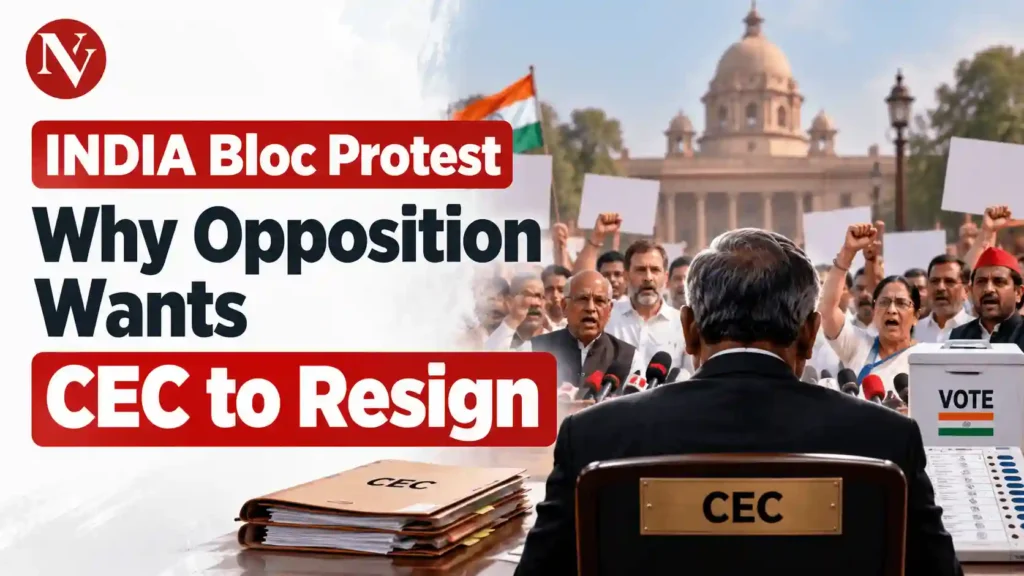
The INDIA bloc has intensified its protests against Chief Election Commissioner (CEC) Gyanesh Kumar, demanding his resignation over alleged irregularities in India’s voter lists.
Opposition leaders, including Rahul Gandhi, Mallikarjun Kharge and Priyanka Gandhi Vadra, have taken to the streets of Delhi, accusing the Election Commission of failing to protect the integrity of the electoral process.
The controversy centres on the Special Intensive Revision (SIR) of electoral rolls, questions about internal decisions within the Election Commission, and concerns over eligible voters potentially losing their voting rights.
But what exactly triggered the protests, and why are Opposition parties demanding the election chief’s resignation?
INDIA Bloc Protest in Delhi: What Happened?
The latest round of demonstrations began on 6 October 2026, when Opposition MPs attempted to march towards the Election Commission’s headquarters in New Delhi.
Police stopped the march, leading to a prolonged confrontation. Rahul Gandhi, Priyanka Gandhi Vadra and several other Opposition leaders were detained before being released.
On 7 October, INDIA bloc leaders attempted another demonstration near Jantar Mantar, but police again prevented them from reaching the planned protest site.
The protests continued on 8 October, when Opposition MPs gathered at Rajghat, Mahatma Gandhi’s memorial, for a peaceful sit-in.
Rahul Gandhi accused the government and the Election Commission of undermining democratic institutions. Congress president Mallikarjun Kharge also raised concerns about citizens’ voting rights.
According to The Indian Express, the alliance has sought a meeting with President Droupadi Murmu to raise its concerns.
What Is the SIR Voter List Controversy?
Special Intensive Revision, commonly called SIR, is an electoral roll verification exercise conducted by the Election Commission of India.
Its stated purpose is to update voter lists by identifying duplicate entries, deceased voters, people who have shifted residence and other ineligible registrations.
In principle, maintaining accurate voter lists is essential for fair elections.
However, the Opposition has questioned how the exercise is being implemented across different states.
Opposition parties allege that large numbers of eligible voters have been removed from electoral rolls, potentially preventing them from exercising their voting rights.
The Election Commission maintains that the revision process is intended to improve the accuracy of voter records.
The central disagreement is whether the exercise is correcting electoral rolls fairly or creating unnecessary difficulties for legitimate voters.
Why Are Opposition Parties Demanding CEC Gyanesh Kumar’s Resignation?
The resignation demand is linked to several allegations concerning voter registration, the Commission’s internal functioning and its independence.
1. Concerns Over Voter List Deletions
One of the Opposition’s biggest objections concerns the removal of names during the SIR exercise.
Congress and other INDIA bloc parties argue that eligible voters could be excluded because of documentation requirements, administrative errors or problems in the verification process.
They have demanded greater transparency and safeguards to ensure genuine voters are not wrongly removed.
However, the number of names removed from draft electoral rolls should not automatically be treated as the number of eligible voters permanently disenfranchised. Claims about wrongful exclusions require verification.
2. Questions Over Internal Election Commission Decisions
The controversy intensified following a September 2026 investigation by The Indian Express.
The investigation reported that Election Commissioners Sukhbir Singh Sandhu and Vivek Joshi had recorded objections at least 14 times over 10 months to several administrative and electoral decisions.
These reportedly included concerns over changes to Form 6, which is used for new voter registration, and the management of electoral databases.
The Election Commission acknowledged the internal observations but described differing views as part of its decision-making process.
The Supreme Court has also clarified that it had not approved modifications to Form 6. However, that clarification should not be interpreted as a final judicial finding that the CEC personally acted illegally.
3. Allegations About the Election Commission’s Independence
Opposition leaders have accused Gyanesh Kumar of failing to maintain the independence expected of the Election Commission.
Rahul Gandhi has repeatedly alleged electoral manipulation, while other INDIA bloc leaders have questioned whether the Commission is acting impartially.
These remain political allegations, not established findings of deliberate wrongdoing by the CEC.
Nevertheless, the controversy has brought renewed attention to transparency and accountability within one of India’s most important constitutional institutions.
What Are the INDIA Bloc’s Main Demands?
The INDIA bloc has raised several demands during the protests.
- CEC’s resignation: Opposition leaders want Gyanesh Kumar to step down over his handling of the electoral roll controversy.
- Review of SIR: The alliance has called for the disputed revision exercise to be stopped or withdrawn.
- Restoration of voter names: Leaders want eligible voters whose names were wrongly deleted to be restored to electoral rolls.
- Greater transparency: Opposition parties are seeking explanations about voter registration procedures and decisions taken within the Election Commission.
Some protesting organisations have also demanded broader electoral reforms, including a return to ballot-paper voting. These should not be confused with every demand formally shared by the INDIA bloc.
How Have the Election Commission and BJP Responded?
The Election Commission has rejected suggestions that its key SIR decisions were taken without the approval of the full Commission.
In September, the poll body stated that major decisions concerning electoral roll revisions had received unanimous approval from all three commissioners.
It also maintained that internal observations and suggestions are normal parts of institutional decision-making.
The Commission subsequently announced procedural changes, including additional assistance for voters facing verification difficulties.
Meanwhile, BJP leaders have dismissed the Opposition’s accusations as politically motivated.
Union Minister Krishan Pal Gurjar questioned the need for street protests while the SIR dispute was already before the Supreme Court. Other BJP representatives accused the Opposition of attempting to undermine confidence in constitutional institutions.
The political disagreement therefore remains unresolved, with both sides presenting sharply different interpretations of the controversy.
What Happens Next in the CEC Resignation Row?
INDIA bloc leaders have indicated that they intend to continue their demonstrations.
They have also requested a meeting with President Droupadi Murmu, although the timing of any such meeting had not been confirmed in the latest reports available on 9 October.
The Supreme Court’s examination of issues connected with the electoral roll revision could also influence the debate.
However, demanding a Chief Election Commissioner’s resignation is different from formally removing the officeholder.
Under Article 324(5) of the Indian Constitution, the CEC can be removed only in the same manner and on the same grounds as a Supreme Court judge.
Political pressure alone does not automatically remove the CEC from office.
Why Does This Controversy Matter to Indian Voters?
Beyond the political confrontation, the issue directly concerns citizens’ participation in elections.
Every eligible voter should have a fair opportunity to register, check their details and correct mistakes in the electoral roll.
A missing name on the final voter list can prevent an otherwise eligible person from voting.
Citizens can use the Election Commission’s voter services portal to search electoral records and access voter registration services.
Regardless of political affiliation, accurate voter lists and transparent verification procedures are essential for public confidence in elections.
Frequently Asked Questions
Who Is India’s Current Chief Election Commissioner?
Gyanesh Kumar is India’s Chief Election Commissioner as of 9 October 2026. He leads the Election Commission, which oversees electoral roll preparation and the conduct of elections.
Can the Chief Election Commissioner Be Removed From Office?
Yes, but the Constitution provides safeguards. The CEC can be removed through the same constitutional process and on the same grounds as a Supreme Court judge. A resignation demand by political parties does not itself trigger removal.
Conclusion
The INDIA bloc protest has brought concerns about voter lists and the Election Commission’s functioning into the national spotlight.
While Opposition leaders continue demanding accountability, the Commission and BJP reject allegations of electoral manipulation.
For the latest developments in Indian politics, follow News Vocal and explore our Politics section.