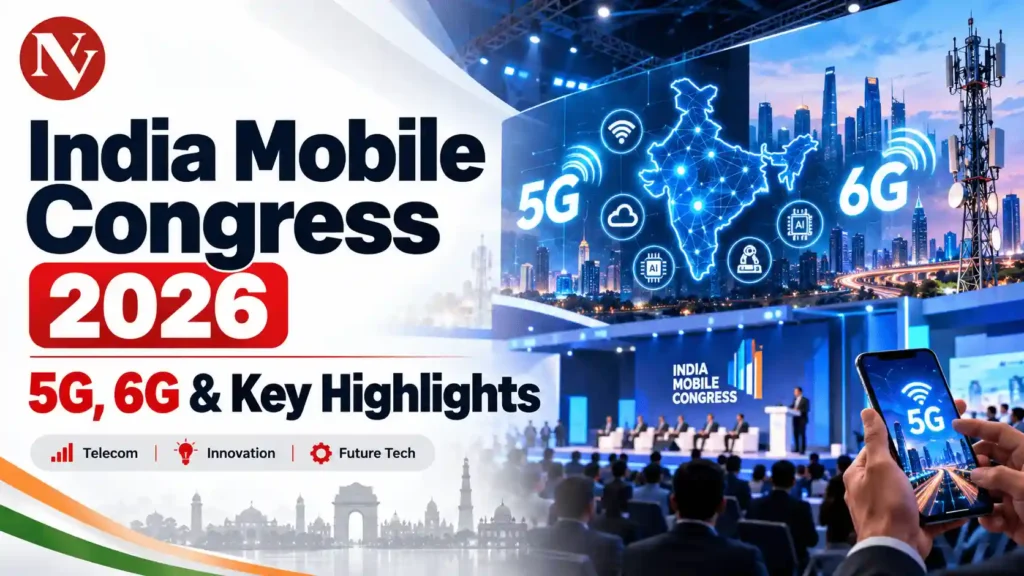
India Mobile Congress 2026 has brought some of the biggest names in technology and telecommunications to New Delhi, with major discussions around 5G expansion, artificial intelligence, satellite connectivity and India’s plans for 6G.
Prime Minister Narendra Modi inaugurated the 10th edition of the event on 8 October 2026 at Yashobhoomi, highlighting India’s progress in digital connectivity.
Among the major developments so far are a target of one billion 5G users by 2030, five new Bharat 6G partnerships and demonstrations of AI-powered telecom networks.
But what do these announcements actually mean for Indian mobile users? Here are the important highlights.
What Is India Mobile Congress 2026?
India Mobile Congress (IMC) is an annual technology and telecommunications event jointly organised by the Department of Telecommunications (DoT) and the Cellular Operators Association of India (COAI).
The 2026 edition is being held from 7 to 10 October at Yashobhoomi, New Delhi, under the theme “Scale Without Boundaries”.
The event brings together telecom operators, technology companies, startups, policymakers and researchers.
Its four main pillars are Srishti (innovation), Samvardhan (growth), Sashakt (opportunities) and Suraksha (security).
More details are available on the official India Mobile Congress website.
India Mobile Congress 2026: Biggest Announcements So Far
Several important announcements have emerged from the event, covering India’s existing mobile networks and future telecommunications technology.
India’s Target of One Billion 5G Users by 2030
Union Communications Minister Jyotiraditya Scindia announced an ambitious goal of reaching one billion 5G users in India by 2030.
According to the government’s official IMC 2026 announcement, India currently has around 550 million 5G users.
Prime Minister Modi also highlighted the rapid expansion of 5G infrastructure since its launch in October 2022.
However, the one-billion-user figure is a future target, not the current number of subscribers.
Bharat 6G Alliance Signs Five New Agreements
Another important announcement came from the Bharat 6G Alliance during the International Bharat 6G Symposium.
On 8 October, the alliance announced five new Memoranda of Understanding (MoUs) with organisations including GSMA, one6G Association and GTI Alliance.
It also released nine technical white papers covering areas such as network security, spectrum, sustainability and future connectivity.
These agreements aim to support international research and technology development.
They do not mean commercial 6G services have launched in India.
Made-in-India Telecom Equipment Gains Attention
Telecom equipment manufacturer Ericsson highlighted its growing manufacturing operations in India.
According to the company’s official announcement, more than 15,000 antennas and 25 million components have been produced in India since July 2025.
India-manufactured antennas are also being exported to Europe and other international markets.
Such developments could strengthen India’s position as a telecom equipment manufacturing and export hub.
What’s New in 5G Technology at IMC 2026?
India’s 5G network has expanded significantly over the past four years.
At the event, Prime Minister Modi said the country had approximately 5.5 lakh 5G base stations, with services reaching every district.
However, district-level availability does not mean uninterrupted 5G coverage in every village, building or remote location.
Companies are also demonstrating 5G Advanced, which builds on existing 5G technology.
It aims to improve network capacity, reliability and performance, particularly in crowded areas.
For users, future improvements could mean smoother video calls, more reliable mobile gaming and better connectivity at large public events.
The actual benefits will depend on network deployment and device compatibility.
Bharat 6G: How Is India Preparing for the Next Generation?
While 5G continues expanding, India has already started working on the next generation of mobile technology.
6G is expected to support advanced applications involving artificial intelligence, connected devices and highly responsive communication networks.
India wants to play a bigger role in developing international 6G standards instead of depending entirely on technologies developed elsewhere.
The Bharat 6G Alliance’s new research documents address important subjects such as spectrum readiness, integrated sensing and communication, and secure networks.
The government’s Bharat 6G Symposium update provides further details.
Commercial 6G services are not yet available in India. The current focus is research, testing, partnerships and technology development.
AI, Smart Devices and Future Technologies at IMC 2026
Artificial intelligence has become an important part of this year’s technology demonstrations.
AI-Powered Telecom Networks
Ericsson is showcasing how AI can help telecom operators manage network traffic, identify technical problems and improve network performance.
Such systems could eventually reduce service disruptions and help networks handle growing data demand more efficiently.
The company is also demonstrating AI-based network automation and 5G Advanced capabilities.
Smart Glasses, Robotics and Connected Services
Another interesting attraction is the use of smart glasses, collaborative robots and intelligent connected devices.
Ericsson’s IMC 2026 technology showcase includes demonstrations involving live translation, navigation and interactive stadium experiences.
Other areas receiving attention include industrial robotics, smart mobility and satellite communications.
These demonstrations show what future networks may support, but not every showcased product is commercially available.
Cybersecurity and Digital Safety Also Take Centre Stage
As India’s digital connectivity grows, cybersecurity has become increasingly important.
At IMC 2026, the Department of Telecommunications is highlighting initiatives including Sanchar Saathi and the Financial Fraud Risk Indicator.
These programmes are designed to strengthen protection against suspicious communications and financial fraud.
Prime Minister Modi has also emphasised the need for cooperation against cyber threats, including digital fraud and deepfakes.
For ordinary users, the message is simple: faster internet and smarter devices must be accompanied by stronger digital safety measures.
Indian Startups Showcase Practical Innovations
India Mobile Congress is also providing a platform for startups developing technology for everyday problems.
At Ericsson’s exhibition, six Innovation Challenge winners are showcasing their solutions.
These include KissanAI, which uses voice and image-based AI to assist farmers, and Skye Air Mobility, which is exploring 5G-supported drone logistics.
Another startup, ScanO, is working on AI-assisted oral health screening, while Torchit focuses on assistive technology for people with visual disabilities.
Such innovations highlight how advanced connectivity can support agriculture, healthcare and accessibility, not just smartphones.
What Do These Developments Mean for Indian Mobile Users?
For most Indians, the immediate question is whether these announcements will improve internet services.
Expanded 5G infrastructure could eventually provide more reliable connectivity in underserved locations.
AI-powered networks may help operators manage congestion, while satellite communication could create additional options in remote areas.
Better connectivity could also support online education, healthcare and small businesses.
However, conference announcements do not guarantee immediate improvements in download speeds, recharge prices or network availability.
Many showcased technologies still require testing, investment and wider deployment.
Frequently Asked Questions
Where Is India Mobile Congress 2026 Being Held?
India Mobile Congress 2026 is being held at Yashobhoomi in New Delhi from 7 to 10 October 2026.
Has 6G Been Launched in India?
No. India is currently working on 6G research, standards, partnerships and testing. Commercial 6G services have not launched.
What Are the Biggest Highlights of IMC 2026?
Major highlights include India’s one-billion 5G user target for 2030, new Bharat 6G partnerships, AI-powered telecom demonstrations and innovations from Indian startups.
Conclusion
India Mobile Congress 2026 shows how India’s telecom industry is moving beyond basic mobile connectivity towards advanced networks, AI-driven services and indigenous technology development.
While some developments are already underway, others will take time to reach consumers.
For more technology news and digital developments, follow News Vocal.