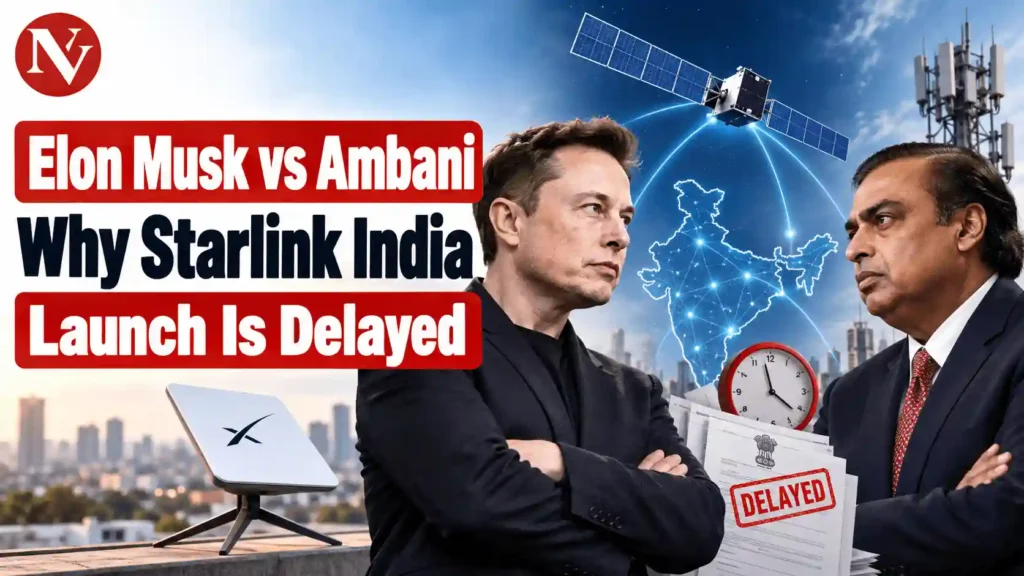
Elon Musk has sparked a fresh controversy in India after questioning whether Reliance Industries chairman Mukesh Ambani is influencing the delayed launch of Starlink, his satellite internet service.
On 8 October 2026, Musk took to X to express frustration over the regulatory hurdles preventing Starlink from starting commercial operations in India. He claimed that the company had spent five years meeting Indian government requirements but was still waiting to launch its services.
His remarks have triggered a debate about competition in India’s telecom industry, government approvals and the influence of major business groups.
However, the Indian government has rejected allegations of unfair treatment, saying all satellite internet operators must complete the same regulatory process.
What Did Elon Musk Say About Mukesh Ambani?
The controversy began when Musk accused unnamed powerful business interests of preventing Starlink from entering India’s internet market.
He suggested that certain businesses were trying to protect their existing market dominance by keeping new competitors out.
On 8 October, Musk directly questioned Mukesh Ambani’s influence, writing on X:
“Is Ambani the real boss of India?”
In the same post on X, Musk said Starlink was licensed in more than 165 countries and questioned why the company still could not begin commercial services in India.
Musk argued that Starlink could improve internet connectivity for people living in areas with poor or no broadband coverage.
However, he did not provide evidence establishing that Ambani or Reliance Jio had interfered with Starlink’s regulatory approval.
What Is Starlink and How Does It Work?
Starlink is a satellite internet service operated by Elon Musk’s SpaceX.
Unlike traditional broadband services that depend mainly on fibre-optic cables or mobile towers, Starlink uses a network of low Earth orbit satellites to provide internet connectivity.
Users typically need a Starlink terminal and supporting equipment to connect to the network.
The technology could be particularly useful in Indian villages, mountainous regions, remote schools and areas where installing conventional broadband infrastructure is difficult.
However, satellite internet is not automatically cheaper than existing services. Its affordability will depend on the final subscription charges and equipment costs in India.
Why Is Starlink’s India Launch Still Delayed?
Although Musk has questioned the delay, Starlink has already secured important regulatory approvals in India.
The remaining requirements involve security compliance and spectrum allocation.
Starlink Already Has a Telecom Licence
Starlink received a Global Mobile Personal Communication by Satellite (GMPCS) licence from India’s Department of Telecommunications in 2025.
It also received authorisation from the Indian National Space Promotion and Authorisation Centre (IN-SPACe) for its satellite constellation.
A government update on satellite communication services published in January 2026 confirmed that Starlink was among three companies granted GMPCS authorisation.
However, holding a telecom licence does not automatically permit a company to begin commercial satellite internet services.
Security Clearance and Spectrum Assignment Are Still Pending
Before starting operations, satellite communication companies must demonstrate compliance with India’s security requirements.
These include safeguards relating to communication networks, users’ data and regulatory oversight.
After completing the security assessment, operators can proceed towards spectrum assignment.
Spectrum refers to the radio frequencies required to transmit signals between satellites and communication equipment.
Until these requirements are completed, Starlink cannot begin full commercial operations in India.
How Has the Indian Government Responded?
India’s Ministry of Communications responded to Musk’s allegations on 8 October 2026.
In an official Press Information Bureau statement, the government maintained that the regulatory framework for satellite communication companies is fair and non-discriminatory.
It explained that three licensed operators, including Starlink, Jio Satellite Communications and OneWeb India, were undergoing security assessments.
The ministry also clarified that all three companies were at broadly the same regulatory stage.
According to the government, operators can seek spectrum assignment after completing the required security checks.
The government rejected suggestions that Starlink was being treated unfairly.
This means the official explanation for the delay is regulatory and security compliance, rather than any confirmed interference from a private company.
Why Is Mukesh Ambani’s Reliance Jio Part of the Starlink Debate?
Mukesh Ambani’s Reliance Jio is one of India’s leading telecom operators and is also developing its presence in satellite broadband.
Its relationship with Starlink includes both business competition and cooperation.
Jio and Starlink Disagreed Over Satellite Spectrum
One major disagreement involved how India should allocate satellite spectrum.
Reliance Jio previously supported auctioning satellite spectrum, while Starlink favoured administrative allocation.
Under an auction system, companies compete by bidding for spectrum. Administrative allocation involves the government assigning spectrum under specified rules and charges.
India eventually adopted the administrative allocation approach for satellite communication services.
This earlier disagreement highlighted differences between the companies’ business interests, but it does not establish that Jio caused Starlink’s current launch delay.
Jio and Starlink Have Also Signed a Partnership Agreement
Interestingly, Reliance Jio and SpaceX are not simply rivals.
On 12 March 2025, Jio Platforms announced an agreement with SpaceX to offer Starlink broadband services to Indian customers, subject to the necessary authorisations.
Under the agreement, Jio plans to make Starlink equipment and services available through its retail and online channels.
Bharti Airtel also announced a separate distribution partnership with SpaceX.
These partnerships show that India’s established telecom operators could potentially work with Starlink while developing competing satellite internet businesses.
Rahul Gandhi Reacts to Musk’s ‘Real Boss’ Remark
The controversy also attracted political attention.
Congress leader Rahul Gandhi responded to Musk’s comments on X on 8 October, welcoming him to India and suggesting that he had yet to discover another influential figure.
Gandhi did not name the individual he was referring to.
Musk subsequently thanked the Congress leader and expressed concern about the situation.
The exchange added a political dimension to what had initially been a dispute over satellite internet approvals.
What Could Starlink’s Entry Mean for Indian Internet Users?
Starlink’s launch could create additional connectivity options, particularly for people living outside major cities.
Remote villages, hill stations, border regions and businesses operating in areas with unreliable internet infrastructure could benefit from satellite broadband.
It could also increase competition in India’s growing internet market.
However, customers should not assume that Starlink will replace affordable mobile data or fibre broadband.
Its usefulness will depend on network coverage, connection reliability, installation costs and monthly subscription prices.
No confirmed nationwide consumer pricing or commercial launch date was available as of 9 October 2026.
When Will Starlink Launch in India?
Starlink has not announced a confirmed date for beginning commercial internet services in India.
The company must complete the pending security assessment and spectrum-related requirements before launching.
While the regulatory process continues, Indian customers should wait for official announcements rather than relying on speculative launch dates or unofficial pricing claims.
Frequently Asked Questions
Has Starlink Received Approval in India?
Yes. Starlink has received a GMPCS telecom licence and IN-SPACe authorisation. However, additional security compliance and spectrum-related steps remain before commercial services can begin.
Is Reliance Jio Blocking Starlink’s India Launch?
Elon Musk has raised concerns about powerful business interests, but there is no established evidence that Reliance Jio is blocking Starlink’s approval. The government says the same regulatory requirements apply to all three licensed operators.
Conclusion
The controversy surrounding the Starlink India launch delay has raised important questions about telecom competition and regulatory transparency.
While Musk has questioned Mukesh Ambani’s influence, the Indian government maintains that security requirements are responsible for the pending approvals.
For more developments in technology, business and India’s digital economy, follow News Vocal and explore our Technology section.